
2025 Community Survey Report Part II: Well-being and Social Support
OPEN’s 2025 Community Survey report offers a detailed look into the lives, experiences, and challenges of non-monogamous individuals. This year’s survey was conducted as formal academic research in partnership with Dr. Amy Moors of Chapman University (IRB #26-13), and was made possible by support from Multiamory, a weekly podcast offering research-backed advice and tools to help non-monogamous relationships thrive, and Feeld, a dating app for the curious.
This second report focuses on factors of resilience, including well-being, and social support networks among people who identify with non-monogamy. Click here to view the full Part II Survey Report.
For the initial report published in December 2025 focusing on the ways in which people practice non-monogamy and experiences of stigma, please see: www.open-love.org/blog/2025-community-survey-report
Want updates on our research, advocacy, resources and events?
Join our email list!
Make a donation to support research and advocacy for non-monogamy!
At a Glance
One-half (53.1%) reported life satisfaction scores that indicated they were highly or very highly satisfied with their life, and 55.2% of respondents reported high to very high levels of self-esteem.
Average levels of life satisfaction and self-esteem decreased as people experienced more instances of stigma and discrimination.
Nearly all respondents reported having two or more sources of moderate to strong instrumental support (tangible help like giving rides to medical appointments; 91.5%), and emotional support (care related help like providing advice for personal problems; 97.7%).
Respondents indicated that their partner/s, spouse/s, and/or connections were their strongest sources of support.
Respondents who were currently receiving caregiving due to a health or personal issue viewed their non-monogamous friends and community as the second strongest source of support.
Life Satisfaction & Self Esteem
Life Satisfaction
Life satisfaction refers to a person’s overall evaluation of their quality of life. Ample research has documented that life satisfaction is linked with better health outcomes, lower job stress and burnout, and, not surprisingly, longer lifespans.
Respondents were asked to indicate the extent to which they agreed or disagreed with five statements regarding their satisfaction with life. Using a validated psychological measure, each respondent’s total score can range from 5 (extremely dissatisfied with life) to a max of 35 (extremely satisfied with life).
The average life satisfaction score was 24 out of 35, which is consistent with average levels in U.S. and international adult samples. 53.1% of respondents were “highly” or “very highly” satisfied with their life.
Self-Esteem
Self-esteem reflects how people perceive their own worth, including the extent to which they see themselves as competent. High levels of self-esteem are robustly linked with success and well-being in intimate relationships, work, and health.
Respondents were asked to indicate their level of self-esteem, using a validated one-item measure: “I have high self-esteem,” using a scale from 1 (not very true of me) to 5 (very true of me).
Average self-esteem score was 3.5 out of 5, which is consistent with average levels in U.S. adult samples. 55.2% of respondents reported “high” or “very high” self esteem.
Stigma & Well-being
We asked people whether they had experienced stigma or discrimination in ten different contexts (e.g., employment, family acceptance, healthcare, etc.). We found an inverse relationship between experiencing non-monogamy-based stigma and discrimination and both well-being outcomes (life satisfaction and self-esteem).
This data demonstrates that higher incidences of stigma and discrimination negatively impact people’s well-being and self-esteem. This was assumed, but is now demonstrated empirically in the data.
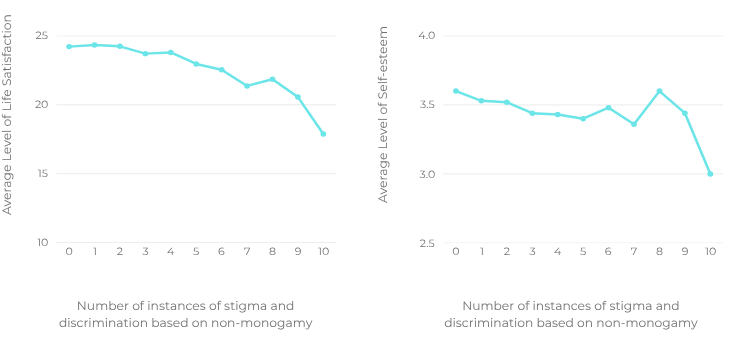
Despite persistent stigma and discrimination, overall measures of well-being and self-esteem are consistent with the general population, suggesting the presence of mitigating factors (i.e., the stigma against non-monogamy lowers well-being, but other factors raise it back to levels consistent with the general population.
Social Support
Support from others can come from many people—partners, family, friends, and more—and often functions in two important ways. Instrumental support is practical or tangible help, like helping with chores or offering advice. Emotional support focuses on care and understanding, such as listening, showing empathy, and helping someone feel valued.
The ability to count on others is also central to theories of health and well-being. Decades of research have found that social support is one of the strongest protective factors of both physical and mental health.
Respondents were asked to indicate the extent to which different categories of people, such as partner(s) and family members, provided instrumental support (tangible help like giving rides to medical appointments) and emotional support (care related help like spending enjoyable time together).
We asked about seven possible sources of social support:
Current partner(s), spouse, and/or connections
Immediate family members (e.g., siblings, parents, cousins),
Ex-partner(s) and/or spouse(s)
The partner(s)/spouse of my partner(s) or connection(s) (e.g., metamours)
Friends who are not a part of my non-monogamous network or community (e.g., monogamous friends)
Friends who are a part of my non-monogamous network or community
Neighbors
Nearly all respondents reported two or more sources (out of seven total possible sources) of moderate or strong instrumental support (91.5%) and emotional support (97.7%).
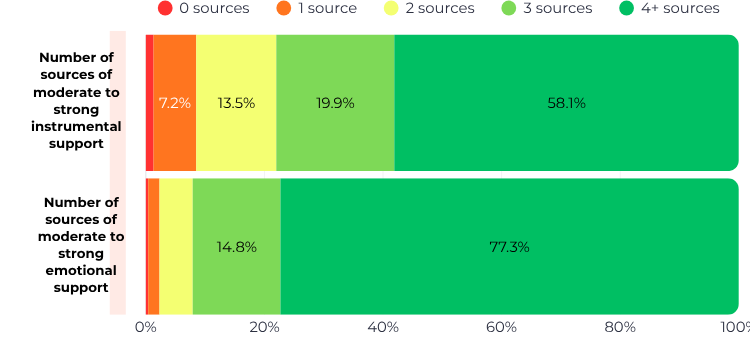
Research indicates that people’s social support networks have decreased over time, and many in monogamous relationships overly rely on their partner/spouse for support. Our findings show a different pattern: because non-monogamous relationships often involve multiple partners or connections, as well as ties to metamours and non-monogamous friends, support can be distributed across a broader network.
In our study, nearly all respondents reported two or more sources of moderate to strong instrumental and emotional support. The most common sources were current partners/connections, family, and friends (both non-monogamous and monogamous).
What’s more, among respondents who were currently receiving caregiving, perceived support from non-monogamous friends and metamours was stronger than among those not receiving caregiving. This finding highlights the unique role of non-monogamy communities in providing practical and emotional support, such as help with meal preparation and a sense of feeling valued.
Join the movement for non-monogamous rights and acceptance and help build resilient and supportive non-monogamous communities!
Conclusions
This research into well-being and social support among non-monogamous people reveals a number of interesting findings.
First, our data demonstrates that higher incidences of stigma and discrimination negatively impact people’s well-being and self-esteem. This was assumed, but is now demonstrated empirically in the data.
Second, despite persistent stigma and discrimination, overall measures of well-being and self-esteem are consistent with the general population, suggesting the presence of mitigating factors (i.e., the stigma against non-monogamy lowers well-being, but other factors raise it back to levels consistent with the general population.
Finally, we observe robust networks of care among non-monogamous people, who tend to have multiple sources of practical and emotional support – particularly from within their non-monogamous relationships and communities.
As society continues to evolve in its understanding of relationships and family structures, the insights from this survey provide a further evidence of the supportiveness and resiliency of non-monogamous relationships, even in the face of persistent stigma.. OPEN's work in these areas is more crucial than ever for promoting acceptance and equality for all relationship structures. Please consider supporting our work with a contribution, and join our email list for updates and opportunities to take action!